

 Facebook
 X
 Pinterest
 Copy Link
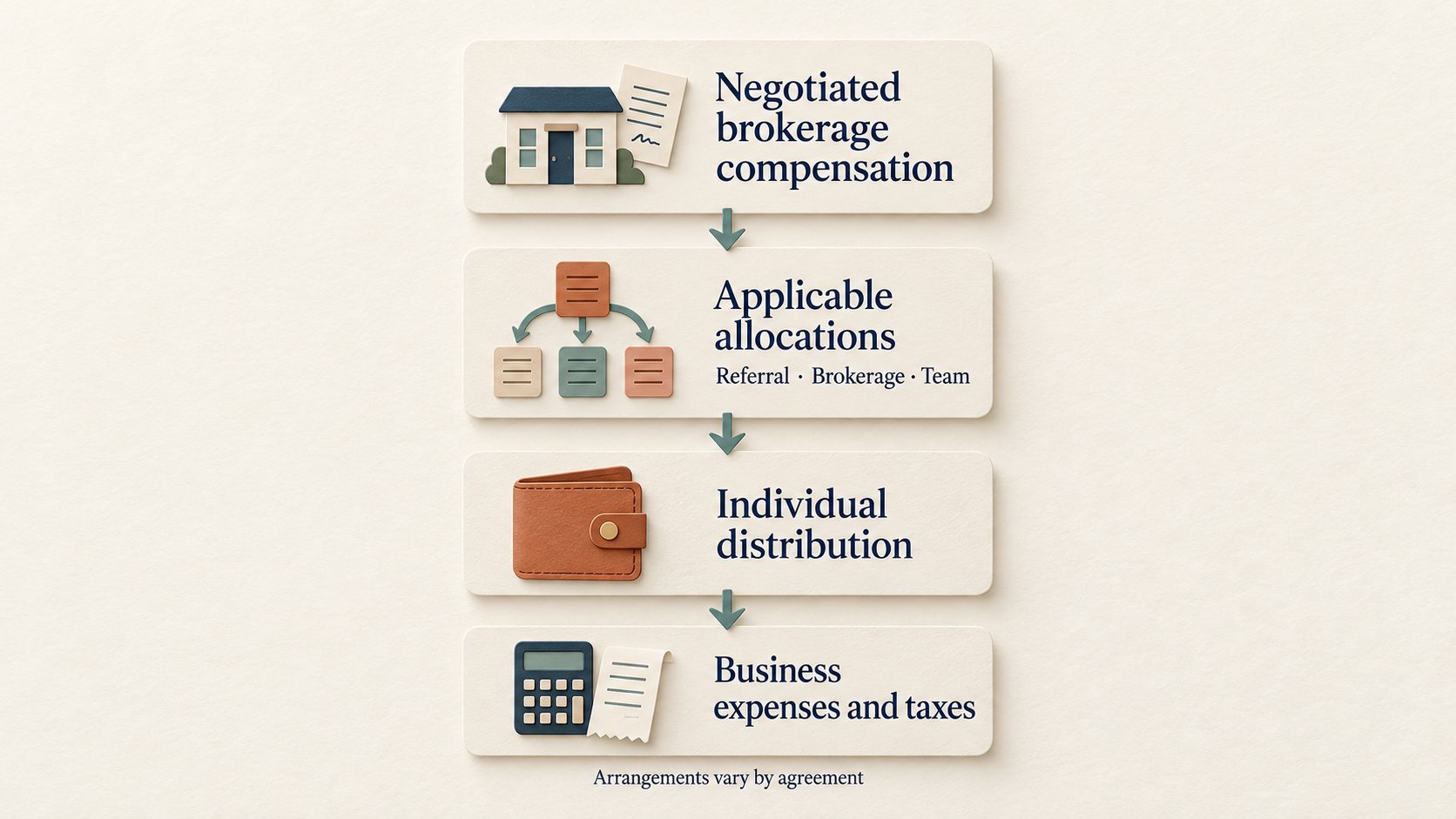
You see a commission amount connected with a home sale and wonder how much the agent actually received. Understanding where real estate commission goes starts with separating the compensation negotiated for brokerage services from the amount eventually available to one individual.
The amounts depend on the agreements involved. There is no single commission rate or split that tells the story of every transaction.
In Part 2 of Behind the Real Estate Transaction, we looked at advertising, prepaid inquiries, and brokerage referrals. This week, we will follow what can happen after brokerage compensation is earned and paid.
Where Real Estate Commission Goes Starts With the Agreement
Begin with the services, the amount or method of calculating compensation, who is responsible for paying, and when payment is due. Those terms belong in the relevant agreements.
The NAR consumer guide to negotiating buyer agreements explains that real estate compensation is negotiable and is not set by law. That applies to the conversation about compensation for the services you are considering, regardless of an agent's internal expenses.
For buyers, ask how any payment from the seller or another permitted source would affect the obligation in your agreement. For sellers, ask what your listing agreement covers and whether you are separately considering compensation toward a buyer's brokerage.
The NAR guide to offers of compensation explains that sellers can choose whether to offer compensation to a buyer's agent. Do not assume one commission amount automatically includes the same services or recipients in every transaction.
The Brokerage and the Individual Have Different Roles
A brokerage is the business through which licensed services are provided. The agent you work with may receive a portion of the brokerage's compensation under a separate arrangement.
The U.S. Bureau of Labor Statistics explains that sales agents work with brokers and often earn a portion of a commission. It also notes that commissions can be divided among agents, brokers, and firms.
That is why a brokerage's gross receipt does not tell you an individual's eventual income. Internal compensation arrangements can differ, and a payment shown in a transaction does not reveal every business expense behind it.
Referral and Team Arrangements Can Add Other Steps
If a qualifying brokerage referral arrangement applies, a referral payment may be part of the distribution. CFPB Regulation X recognizes a specific provision for real estate brokerage referral arrangements when all parties act in a real estate brokerage capacity. It is not blanket permission to pay any business for a referral.
An agent may also work under a team arrangement with its own allocation of compensation. Whether a referral, brokerage allocation, or team allocation applies, and the order in which it is calculated, depends on the actual agreements and applicable requirements.
These are distinct questions. A team arrangement does not necessarily mean a separate referral fee exists, and a brokerage referral does not establish how the receiving agent and brokerage divide their compensation.
A Hypothetical Example Makes the Difference Clear
The following dollar amounts are invented only to illustrate the math. They are not Casey's compensation, a recommended fee, or a typical local arrangement.
Suppose one brokerage receives $8,000 for its services in a transaction. In this example only, the applicable agreements provide for:
- A $1,200 payment under a qualifying brokerage referral arrangement
- A $2,000 allocation to the receiving brokerage
- A separate $800 team allocation
- A remaining $4,000 distribution to the individual agent
The allocations total $8,000. The example covers one brokerage's receipt, not the entire transaction's closing costs or compensation for both sides.
The individual's $4,000 distribution would still need to be considered alongside business expenses and taxes. Another arrangement could have different allocations or none of these additional steps. No consumer should use this illustration to calculate a fee they owe.
Business Revenue Still Has Expenses
Running a real estate business can involve marketing, licensing, technology, transportation, and other operating costs. Which costs the brokerage, team, or individual pays depends on how that business is organized.
Tax treatment also depends on the facts. The IRS explains that licensed real estate agents can be treated as self-employed for federal tax purposes when specified compensation and written-contract conditions are met. A tax professional should address an individual's situation.
Understanding these expenses can explain the path from revenue to income. Your own decision should still focus on the services offered, the proposed price, and the obligations you are willing to accept.
Questions Worth Asking Before You Sign
Ask the professional to walk through the proposed arrangement in plain language:
- What services are included in the compensation?
- How is the amount calculated, and when could it become due?
- What would I owe if another party pays some of it?
- Are any additional fees part of my agreement?
- Does a referral arrangement affect my obligations?
- What would happen if the agreement ends or a transaction does not close?
The Bottom Line
Follow both the service agreement and the money. Brokerage compensation, internal allocations, and an individual's income answer different questions.
Ask Casey how compensation and obligations would be explained in your proposed agreement. A clear conversation before you sign gives you a better basis for deciding how to move forward.
Next in Behind the Real Estate Transaction, we will look at why an agent may respond so quickly to an online inquiry. Later in the series, we will apply these questions to buyer agreements.
Discuss compensation and obligations
Casey Cornelius, REALTOR®
Coldwell Banker Kennon & Parker
Columbus, GA | Phenix City, AL | Fort Benning Area
Phone: 910-527-3714
Email: casey.cornelius@kpdd.com
